

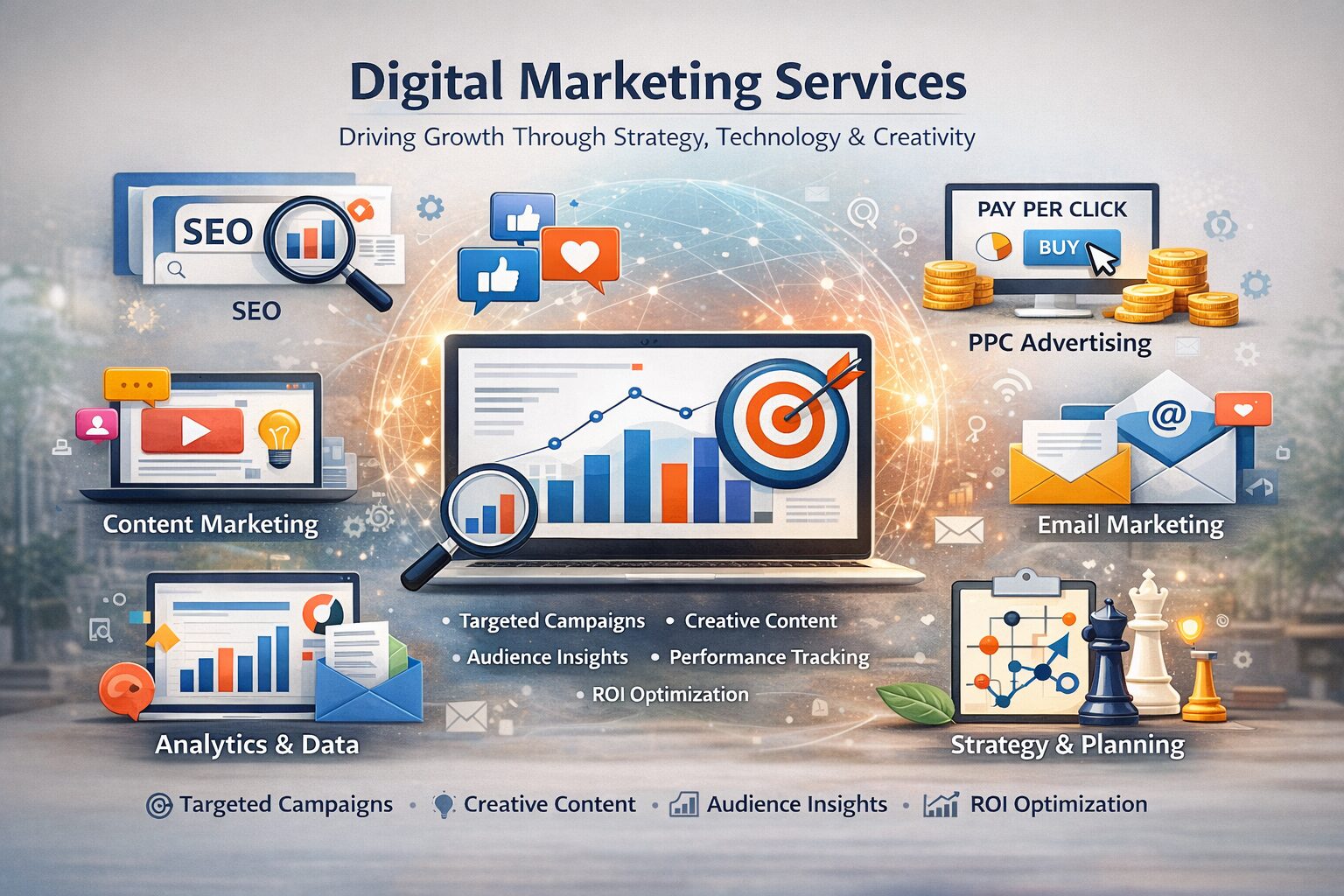
Comprehensive Digital Marketing Services
Digital marketing services today extend far beyond traditional promotion and advertising. They represent a holistic, data-driven, and experience-focused approach to building meaningful connections between brands and their audiences. In a highly competitive digital landscape, businesses must move beyond fragmented efforts and adopt integrated strategies that combine creativity, technology, and analytics.
Modern digital marketing is centered on delivering value at every stage of the customer journey. It focuses on creating personalized experiences, optimizing interactions, and ensuring consistency across all touchpoints. By aligning strategy with execution, businesses can not only improve visibility but also drive engagement, conversions, and long-term growth.
Rather than relying on isolated campaigns, organizations now operate within a unified ecosystem where every channel, message, and interaction contributes to a cohesive brand experience. This integrated approach enhances efficiency, improves performance, and ensures that marketing efforts deliver measurable outcomes.
Search Visibility and Organic Growth
Search Optimization Strategy
Search optimization focuses on improving a brand’s presence in organic search results by aligning website structure, technical performance, and content with search engine algorithms. It involves a combination of on-page optimization, technical SEO, and off-page strategies.
Key elements include keyword research, content optimization, site architecture improvements, and performance enhancements such as page speed and mobile responsiveness. These efforts ensure that search engines can effectively crawl and index the website.
A strong search optimization strategy not only improves rankings but also enhances user experience, making it easier for audiences to find and engage with the brand.
Content-Led SEO Approach
Modern SEO is driven by content quality and user intent rather than just keywords. Creating informative, relevant, and engaging content helps attract users who are actively searching for solutions.
Content-led SEO focuses on understanding user queries, addressing pain points, and providing value through well-structured and optimized content.
This approach improves engagement, reduces bounce rates, and increases the likelihood of conversions while strengthening overall visibility.
Authority and Long-Term Impact
SEO builds long-term authority by establishing credibility and trust with both users and search engines. High-quality backlinks, consistent content updates, and strong technical performance contribute to authority building.
Unlike short-term marketing tactics, SEO provides sustainable growth and continuous traffic over time, making it a critical component of digital strategy.
Social Media and Engagement Strategy
Audience-Centric Communication
Social media marketing focuses on engaging audiences through relevant, personalized, and interactive communication. It allows brands to connect directly with users, understand their preferences, and respond to their needs.
Audience-centric strategies ensure that content resonates with users, improving engagement and building stronger relationships.
Content and Community Building
Social platforms enable brands to create communities where users can interact, share experiences, and engage with content. This fosters a sense of belonging and loyalty.
Community-driven engagement transforms passive audiences into active participants and advocates for the brand.
Real-Time Brand Interaction
One of the key advantages of social media is the ability to interact in real time. Brands can respond to trends, address customer queries, and participate in conversations instantly.
This responsiveness enhances brand perception and builds trust.
Platform-Specific Strategy and Adaptation
Each social platform has its own format, audience behavior, and content style. Adapting strategies to suit each platform while maintaining brand consistency ensures effective communication.
Content and Experience Marketing
Strategic Content Creation
Content marketing focuses on creating valuable, informative, and engaging content that aligns with audience needs and business objectives. This includes blogs, videos, guides, case studies, and visual assets.
Strategic content creation ensures that every piece of content serves a purpose, whether it is to inform, engage, or convert.
Customer Journey Alignment
Content plays a critical role in guiding users through the customer journey. It provides awareness at the top of the funnel, detailed insights during consideration, and reassurance at the decision stage.
Aligning content with user intent ensures that communication remains relevant and effective at every stage.
Brand Authority and Trust Building
Consistent and high-quality content establishes the brand as a trusted authority in its industry. It builds credibility by providing valuable insights and demonstrating expertise.
Trust is a key factor in influencing decision-making and driving long-term loyalty.
Content Personalization and Experience Design
Personalized content enhances user experience by delivering relevant information based on user behavior and preferences. Experience design ensures that content is easy to consume, visually appealing, and engaging.
Performance Marketing and Paid Media
Targeted Campaign Execution
Performance marketing focuses on delivering measurable outcomes through targeted paid campaigns. These campaigns are designed to achieve specific objectives such as clicks, leads, or conversions.
Clear targeting and goal alignment ensure that campaigns deliver maximum impact.
Audience Segmentation and Precision
Advanced segmentation techniques allow brands to reach specific audience groups based on demographics, behavior, and interests. This improves efficiency and reduces wasted spend.
Continuous Optimization
Performance campaigns are continuously monitored and optimized using data insights. Adjustments to targeting, creatives, and bidding strategies ensure improved performance.
Scalability and ROI Enhancement
Successful campaigns can be scaled to reach larger audiences while maintaining efficiency. Data-driven optimization ensures higher return on investment.
Direct Communication Channels
Email Marketing and Automation
Email marketing enables personalized communication with users through targeted campaigns and automated workflows. It is an effective channel for delivering relevant messages at the right time.
Relationship Nurturing
Direct communication channels help nurture relationships by maintaining consistent interaction with users. They support lead nurturing, onboarding, and retention.
Personalization at Scale
Automation and segmentation allow brands to deliver personalized experiences to large audiences without compromising relevance.
Lifecycle Marketing Integration
Email and messaging platforms support lifecycle marketing by engaging users at different stages, from acquisition to retention and re-engagement.
Analytics and Intelligence Layer
Performance Tracking and Insights
Analytics tools provide detailed insights into user behavior, campaign performance, and engagement patterns. These insights help identify strengths and areas for improvement.
Data-Driven Decision Making
Data enables businesses to make informed decisions based on evidence rather than assumptions. It supports strategy refinement and performance optimization.
Continuous Improvement Cycle
Analytics create a feedback loop that supports ongoing optimization. Insights from performance data are used to refine strategies and improve outcomes.
Predictive Analytics and Future Planning
Advanced analytics help forecast trends and anticipate user behavior, enabling proactive strategy development. This ensures that marketing efforts remain relevant and competitive.
Digital Marketing Execution Framework
A successful digital marketing strategy is built on a structured execution framework that ensures alignment, consistency, and measurable outcomes. This framework provides a clear roadmap for planning, executing, and optimizing marketing efforts across channels.
Strategic Objective Setting
Every campaign begins with clearly defined objectives that align with broader business goals. These objectives provide direction and establish measurable benchmarks for success.
Whether the goal is to increase brand awareness, generate leads, improve conversions, or enhance customer retention, clarity at this stage ensures focused execution.
Well-defined objectives also help teams prioritize efforts and allocate resources efficiently.
Audience Mapping and Segmentation
Understanding the audience is critical to delivering relevant and impactful communication. Audience mapping involves identifying key segments based on demographics, behavior, interests, and intent.
Segmentation enables personalized marketing strategies that resonate with different audience groups. It ensures that the right message reaches the right audience at the right time.
Advanced segmentation also improves efficiency by reducing wasted efforts and increasing engagement.
Integrated Planning
A comprehensive marketing plan ensures that all channels, content, and activities are aligned with the overall strategy. Integrated planning brings together different teams and functions to work toward a common objective.
This approach eliminates silos and ensures consistency in messaging, branding, and execution across platforms.
It also allows for better coordination and resource utilization.
Cross-Channel Execution
Executing campaigns across multiple platforms ensures maximum reach and engagement. Each channel contributes uniquely to the overall strategy while maintaining a consistent brand message.
Cross-channel execution allows brands to connect with audiences at different touchpoints, creating a seamless experience.
Consistency across channels strengthens brand recognition and improves overall effectiveness.
Performance Monitoring
Tracking key metrics such as traffic, engagement, click-through rates, and conversions provides insights into campaign performance.
Monitoring helps identify what is working and what needs improvement, enabling data-driven decision-making.
Real-time tracking ensures that strategies can be adjusted quickly to improve outcomes.
Optimization and Scaling
Optimization involves refining strategies based on performance data to improve efficiency and effectiveness. This includes adjusting targeting, content, and channel strategies.
Once successful strategies are identified, they can be scaled to reach larger audiences and generate greater impact.
This continuous improvement cycle ensures sustained growth and long-term success.
Digital Marketing Channel Ecosystem
Digital marketing relies on a diverse set of channels working together to create a cohesive and effective strategy. Each channel plays a specific role in driving visibility, engagement, and conversions.
Search and Discovery Platforms
Search engines serve as primary discovery platforms where users actively look for information, products, and services. Both organic search (SEO) and paid search (PPC) play crucial roles in capturing high-intent traffic.
These platforms are essential for visibility, as they connect brands with users at critical decision-making moments.
Optimizing for search ensures consistent traffic and improved discoverability.
Social and Community Platforms
Social media platforms enable brands to engage with audiences, share content, and build communities. They provide opportunities for real-time interaction and feedback.
These platforms help strengthen relationships, improve brand awareness, and encourage user participation.
Community-driven engagement fosters loyalty and advocacy.
Owned Digital Platforms
Websites and landing pages act as central hubs where users interact with the brand and take action. These platforms provide detailed information and guide users through the conversion process.
Optimized design, content, and user experience improve engagement and increase conversion rates.
Owned platforms ensure complete control over messaging and branding.
Direct Communication Channels
Email and messaging platforms enable personalized and direct communication with audiences. These channels are effective for nurturing leads and maintaining relationships.
Personalization improves relevance, engagement, and retention.
Consistent communication strengthens trust and long-term connections.
Content Distribution Platforms
Content platforms such as blogs, video channels, and publishing sites support storytelling and knowledge sharing. They help build authority and engage audiences over time.
Consistent content distribution ensures sustained visibility and interaction.
These platforms play a key role in supporting the customer journey.
Challenges in Modern Digital Marketing
Digital marketing is constantly evolving, bringing new challenges that require adaptability, innovation, and strategic thinking. Businesses must navigate these challenges to maintain effectiveness and competitiveness.
Managing Multiple Platforms
Handling multiple channels simultaneously can be complex, as each platform requires a unique approach while maintaining overall consistency.
Coordinating efforts across platforms requires strong planning and execution.
Content Saturation and Competition
The digital space is crowded with content, making it difficult to capture attention. Brands must focus on creativity, differentiation, and value to stand out.
High competition requires continuous innovation and strategic planning.
Changing Algorithms and Trends
Search engines and social platforms frequently update their algorithms, impacting visibility and performance. Staying updated is essential for maintaining effectiveness.
Adapting to trends ensures relevance and competitiveness.
Complex Performance Measurement
Measuring effectiveness across multiple touchpoints is challenging due to the complexity of user journeys. Attribution models must consider interactions across channels.
Advanced analytics tools are required to understand performance accurately.
Resource and Budget Constraints
Managing campaigns requires time, budget, and expertise. Allocating resources efficiently while maintaining quality can be challenging.
Overcoming these challenges requires a combination of strategic planning, creativity, and data-driven execution.
How ibs fulcro Approaches Digital Marketing
At ibs fulcro, digital marketing is approached as a fully integrated system that combines strategic insight, creative execution, and advanced analytics. The focus is on delivering measurable outcomes while maintaining consistency across all channels.
The process begins with understanding the market, audience, and business objectives. This insight forms the foundation for developing tailored strategies.
Creative content and storytelling are used to capture attention and engage audiences. Multi-channel execution ensures maximum reach and consistency.
Continuous monitoring and optimization enable strategies to evolve and improve over time, ensuring sustained performance and growth.
This integrated approach ensures improved engagement, stronger brand positioning, and long-term success.
Best Practices for Digital Marketing Excellence
- Align strategies with business goals to ensure measurable impact and clear direction
- Focus on audience-centric communication to improve relevance and engagement
- Create high-value content that educates, informs, and builds trust
- Use integrated multi-channel strategies to maintain consistency and maximize reach
- Leverage data and analytics for continuous optimization and better decision-making
- Adapt to trends and technologies to remain competitive in a dynamic environment
- Maintain consistency in messaging to strengthen brand identity and recall
- Continuously test and optimize to improve performance and efficiency over time
Digital marketing is not just about visibility, it is about creating connected experiences that turn attention into engagement and engagement into growth

