


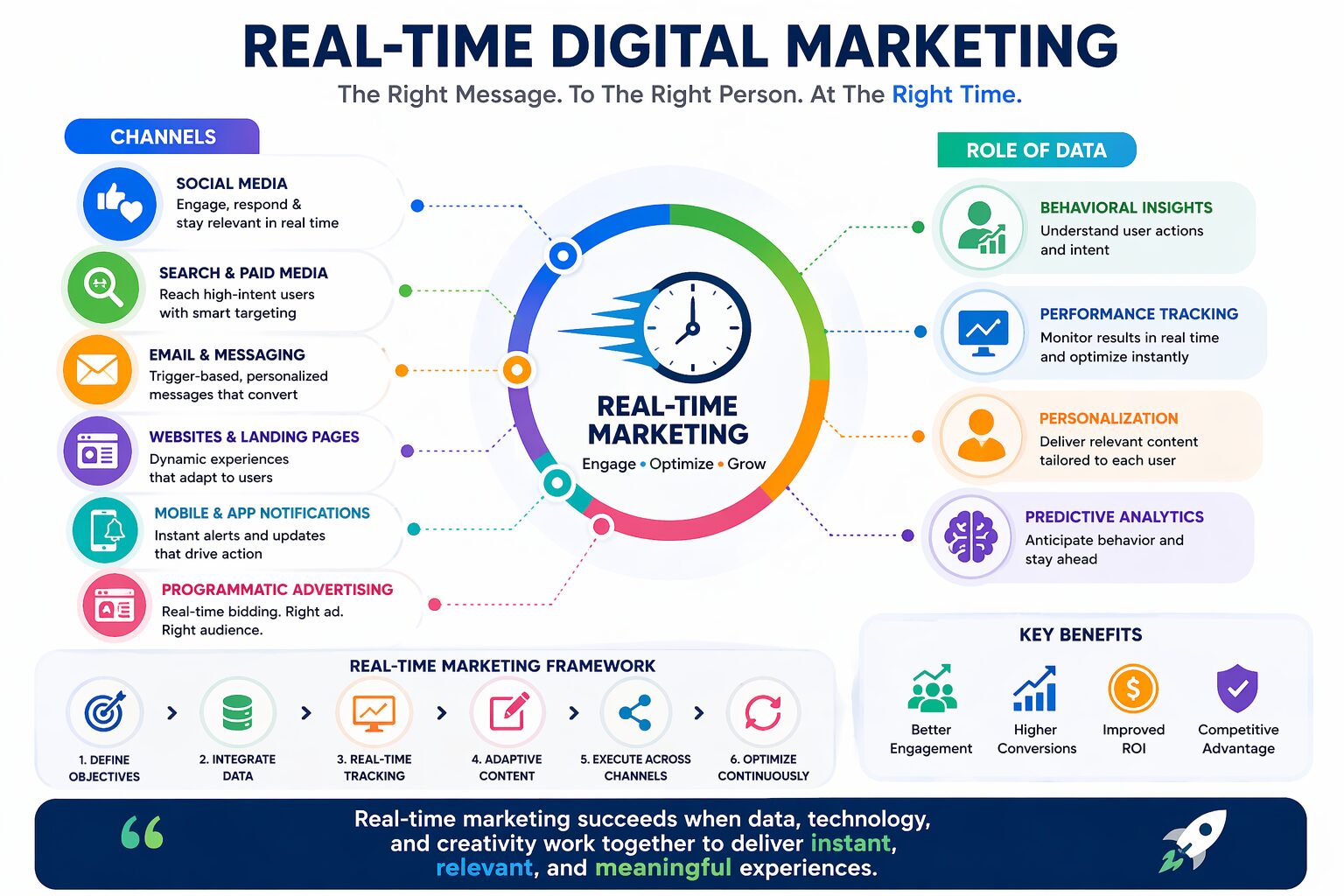
Real-time digital marketing represents a shift from reactive campaigns to adaptive, intelligence-driven marketing systems. In high-performance environments, success is no longer defined by static planning but by the ability to sense, respond, and optimize continuously.
Modern campaigns operate in a dynamic ecosystem where user intent, behavior, and context change instantly. Real-time marketing enables brands to capture these signals, translate them into insights, and act on them immediately to deliver relevant and impactful experiences.
This approach transforms marketing into a continuous performance engine where every interaction contributes to measurable growth.
Understanding Real-Time Marketing in a Performance Context
Real-time digital marketing is not just about speed—it is about intelligent responsiveness. It combines live data, automation, and adaptive strategies to ensure that campaigns remain aligned with user intent at every moment.
In high-performance campaigns, this means moving beyond scheduled execution to dynamic engagement where decisions are made instantly based on real-world signals.
Strategic Foundations of Real-Time Marketing
Data-First Decision Systems
At the core of real-time marketing is a data-first approach where decisions are driven by live insights rather than assumptions. Data streams from multiple touchpoints are analyzed continuously to guide campaign actions.
This ensures accuracy, relevance, and efficiency in every interaction.
Adaptive Campaign Architecture
High-performance campaigns are designed to adapt in real time. This includes flexible messaging, dynamic creatives, and adjustable targeting strategies.
Adaptive systems allow campaigns to evolve based on performance and user behavior.
Speed with Precision
Real-time marketing balances speed with accuracy. While rapid execution is essential, it must be supported by precise targeting and relevant messaging.
This ensures that fast actions also deliver meaningful outcomes.
Continuous Feedback Loops
Real-time campaigns operate on continuous feedback loops where data is constantly analyzed and used to refine strategies.
This iterative process drives ongoing improvement and optimization.
Real-Time Campaign Execution Model
The real-time campaign execution model is a dynamic and continuously evolving system designed to capture user intent, translate it into actionable insights, and activate marketing responses instantly. Unlike traditional campaign models that rely on pre-defined timelines, real-time execution operates on live signals, ensuring that every interaction is relevant, timely, and performance-driven.
This model is built on speed, intelligence, and adaptability, allowing brands to respond to user behavior and market changes as they happen.
Signal Detection
The execution process begins with identifying and capturing signals from multiple touchpoints such as website interactions, social media engagement, search queries, app usage, and campaign responses.
These signals include clicks, page views, dwell time, scrolling behavior, purchase intent, and even inactivity patterns.
By continuously monitoring these signals, businesses gain a real-time understanding of user intent and market dynamics.
Advanced tracking technologies, APIs, and event-based systems ensure accurate and immediate signal capture.
Insight Generation
Once signals are collected, data processing systems transform them into actionable insights. This involves analyzing patterns, identifying trends, and detecting opportunities for engagement.
Real-time analytics platforms process large volumes of data instantly, enabling marketers to understand what users want and how they behave.
Insights highlight high-value segments, emerging trends, and potential optimization areas.
This step bridges the gap between raw data and strategic action.
Dynamic Decision Making
Based on generated insights, decisions are made instantly regarding targeting, messaging, content delivery, and channel allocation.
Dynamic decision-making systems leverage automation and AI to select the most effective actions in real time.
This includes adjusting bids, modifying creatives, reallocating budgets, and refining audience segments.
Such responsiveness ensures that campaigns remain aligned with user intent and performance goals.
Instant Activation
Once decisions are made, campaign elements are activated immediately across relevant channels. This includes deploying ads, sending emails, triggering notifications, or updating website content.
Instant activation ensures that users are engaged at the most impactful moment, increasing the likelihood of interaction and conversion.
Automation plays a crucial role in enabling seamless and immediate execution without delays.
Performance Optimization
Real-time campaigns are continuously monitored and optimized based on live performance data. Metrics such as engagement rates, click-through rates, conversions, and user behavior are analyzed to refine strategies.
Optimization involves testing variations, adjusting targeting, and improving messaging.
This iterative process ensures that campaigns evolve and improve throughout their lifecycle.
Feedback Loop and Learning System
The execution model operates as a continuous feedback loop where every action generates new data that feeds back into the system.
This learning mechanism enables campaigns to become smarter over time, improving accuracy and efficiency.
Real-Time Marketing Ecosystem
The real-time marketing ecosystem consists of interconnected layers that work together to deliver seamless and responsive user experiences. Each layer plays a specific role in capturing attention, driving engagement, and optimizing performance.
Engagement Layer
The engagement layer includes platforms such as social media, messaging apps, and interactive channels that enable direct communication with users.
These platforms support real-time conversations, feedback, and participation, making them essential for building relationships and driving interaction.
Features such as live streaming, comments, and instant responses enhance immediacy and engagement.
Discovery Layer
The discovery layer focuses on capturing user intent through search engines, paid media, and programmatic advertising platforms.
These channels connect users with relevant content and solutions at the moment of need.
Real-time bidding, keyword optimization, and audience targeting ensure efficient traffic acquisition.
Experience Layer
The experience layer includes websites, landing pages, and applications that deliver personalized and adaptive user experiences.
Content, layout, and messaging are dynamically adjusted based on user behavior and context.
This layer plays a critical role in guiding users through the journey and driving conversions.
Retention Layer
The retention layer focuses on maintaining ongoing engagement through email, push notifications, and loyalty programs.
These channels help nurture relationships, encourage repeat interactions, and build long-term customer value.
Real-time triggers ensure that communication remains relevant and timely.
Intelligence Layer
The intelligence layer acts as the central system that connects all channels and provides actionable insights.
Analytics platforms, data warehouses, and AI tools process information and guide decision-making.
This layer ensures that all marketing activities are data-driven and optimized continuously.
Integration Layer
The integration layer ensures seamless communication between different platforms, tools, and data sources.
It enables unified data flow, ensuring that insights are shared across channels for coordinated execution.
Role of Intelligence and Data in Real-Time Marketing
Data and intelligence form the foundation of real-time marketing, enabling brands to understand, predict, and influence user behavior. They transform marketing from static execution to dynamic, adaptive systems that respond to every interaction.
Live Behavioral Mapping
Real-time tracking of user interactions provides detailed insights into behavior, intent, and preferences.
This includes monitoring navigation paths, engagement patterns, and conversion signals.
Behavioral mapping helps identify opportunities for personalization and optimization.
Contextual Personalization
Data enables brands to deliver personalized experiences based on context such as location, device, time, and behavior.
This ensures that messaging is relevant, timely, and impactful.
Personalization improves engagement and strengthens user relationships.
Predictive Optimization
Advanced analytics and machine learning models use historical and real-time data to predict future behavior.
This allows businesses to anticipate user needs, optimize campaigns proactively, and improve outcomes.
Predictive optimization enhances efficiency and competitiveness.
Performance Intelligence
Real-time metrics provide visibility into campaign performance, including engagement, conversions, and ROI.
This enables marketers to make immediate adjustments and improve effectiveness.
Performance intelligence ensures that campaigns remain aligned with objectives.
Decision Intelligence Systems
Decision intelligence combines data, analytics, and automation to guide real-time decision-making.
It ensures that actions are based on insights rather than assumptions, improving accuracy and efficiency.
Continuous Learning and Adaptation
Data-driven systems continuously learn from interactions, improving targeting, messaging, and strategy over time.
This creates a self-improving ecosystem that evolves with user behavior and market changes.
Data Governance and Privacy
Responsible data usage is essential for maintaining trust and compliance. Ensuring data privacy and security is a key component of real-time marketing strategies.
Overall, intelligence and data transform real-time marketing into a powerful system that delivers faster, smarter, and more impactful results.
Advantages of Real-Time Marketing in High-Performance Campaigns
- Higher Engagement Levels through timely and relevant communication
- Improved Conversion Efficiency by targeting users at peak intent moments
- Enhanced User Experience through personalization and responsiveness
- Greater Campaign Agility with the ability to adapt instantly
- Optimized Resource Utilization through data-driven decision-making
Challenges in Real-Time Marketing Execution
Real-time digital marketing offers significant advantages in terms of speed, relevance, and performance. However, executing campaigns in real time introduces a range of complexities that require careful planning, advanced technology, and skilled expertise. As campaigns become more dynamic and data-driven, organizations must address multiple operational, technical, and strategic challenges to ensure effectiveness.
Understanding and managing these challenges is essential for building a sustainable and high-performing real-time marketing system.
Data Overload
Real-time marketing relies on continuous data streams from multiple sources, including websites, social media, paid campaigns, and customer interactions. Managing this large volume of data can be overwhelming.
Processing, filtering, and interpreting data in real time requires advanced analytics tools and efficient data management systems.
Without proper data prioritization, businesses risk making inaccurate decisions or missing critical insights.
Effective data governance and structured analytics frameworks are essential to transform raw data into meaningful intelligence.
Integration Complexity
Real-time marketing depends on the seamless integration of multiple platforms such as CRM systems, analytics tools, advertising platforms, and automation software.
Ensuring smooth data flow across these systems can be technically challenging and requires robust infrastructure.
Integration issues can lead to data silos, inconsistencies, and delays in execution.
A unified technology stack and API-driven architecture are critical for enabling efficient integration.
Maintaining Consistency
While real-time marketing requires rapid adaptation, maintaining consistent messaging and brand identity across channels is essential.
Different platforms have unique formats and audience behaviors, making it challenging to ensure uniform communication.
Inconsistent messaging can confuse users and weaken brand perception.
Establishing clear brand guidelines and centralized content strategies helps maintain consistency.
Balancing Speed and Accuracy
Speed is a defining characteristic of real-time marketing, but rapid execution must be balanced with accuracy and quality.
Incorrect targeting, poorly timed messaging, or errors in automation can negatively impact campaign performance.
Ensuring accuracy requires reliable data, validation processes, and continuous monitoring.
Combining automation with human oversight helps maintain this balance effectively.
Technology and Infrastructure Limitations
Real-time marketing requires advanced infrastructure capable of handling high data volumes and rapid processing.
Organizations may face challenges related to system scalability, latency, and performance.
Investing in cloud-based solutions and scalable architectures can address these limitations.
Skill and Resource Gaps
Executing real-time campaigns requires expertise in data analytics, automation, content strategy, and performance marketing.
Limited availability of skilled professionals can impact execution quality.
Continuous training and collaboration across teams are essential for overcoming this challenge.
Privacy and Compliance Concerns
Handling user data in real time requires strict adherence to privacy regulations and ethical practices.
Ensuring compliance while delivering personalized experiences can be complex.
Transparent data practices and secure systems are essential for building trust.
Addressing these challenges requires a combination of strategic planning, advanced technology, skilled expertise, and continuous optimization.
How ibs fulcro Enables Real-Time High-Performance Campaigns
At ibs fulcro, real-time digital marketing is implemented as an integrated and performance-driven system that combines strategy, technology, and analytics to deliver measurable outcomes.
Strategic Alignment with Business Objectives
The process begins with a deep understanding of business goals, target audience, and market dynamics. This ensures that all real-time strategies are aligned with overall objectives.
Advanced Data Integration and Intelligence
Data from multiple sources is integrated into a unified system to provide a comprehensive view of user behavior and campaign performance.
Advanced analytics and AI tools are used to generate actionable insights in real time.
Adaptive Content and Personalization
Content strategies are designed to be flexible and adaptive, enabling real-time personalization based on user behavior and context.
This ensures that communication remains relevant and engaging.
Multi-Channel Execution
Campaigns are executed across multiple platforms, including social media, search engines, websites, and messaging channels.
Each channel is optimized to deliver consistent messaging while leveraging its unique strengths.
Continuous Monitoring and Optimization
Performance is monitored continuously using real-time metrics and analytics dashboards.
Insights are used to refine strategies, improve targeting, and enhance campaign effectiveness.
Scalable and Agile Systems
The approach is designed to scale with business growth and adapt to changing market conditions.
Agile methodologies ensure that campaigns remain flexible and responsive.
This integrated approach ensures that campaigns are not only effective but also sustainable, delivering long-term growth and competitive advantage.
Best Practices for Real-Time Digital Marketing
Implementing best practices ensures that real-time marketing strategies are efficient, effective, and aligned with business goals.
- Adopt a data-first mindset to ensure that all decisions are based on accurate and actionable insights rather than assumptions
- Build flexible and adaptive campaign structures that allow real-time adjustments in targeting, messaging, and execution
- Leverage automation and AI tools to improve speed, efficiency, and scalability while maintaining accuracy
- Focus on delivering contextual and personalized experiences to enhance relevance and engagement across all touchpoints
- Ensure seamless integration across channels and platforms to enable coordinated and consistent execution
- Continuously monitor, test, and optimize campaigns using real-time data and performance insights
- Maintain consistency in messaging and brand identity across all channels while adapting to platform-specific requirements
- Invest in scalable technology and infrastructure to support real-time data processing and execution
- Encourage collaboration across teams to align strategy, execution, and analysis
- Prioritize data privacy and compliance to build trust and ensure long-term sustainability
Real-time marketing excellence is achieved when speed, intelligence, and strategy come together to deliver precise, adaptive, and impactful experiences


